

What are the Modern Indoor Playground Design Features for Cognitive Development?
May 21, 2026
In today's fast - paced world, parents are constantly on the lookout for ways to stimulate their children's cognitive development. Modern indoor playgrounds have emerged as a fantastic solution, offering a blend of fun and learning. As a modern indoor playground design supplier, I've seen firsthand how these spaces can be transformed into hubs of cognitive growth. So, let's dive into the key design features that contribute to cognitive development in modern indoor playgrounds.
Interactive Zones
One of the most crucial design features is the creation of interactive zones. These areas are designed to engage children in hands - on activities that boost cognitive functions such as problem - solving, creativity, and logical thinking. For instance, a construction zone with building blocks allows kids to experiment with different shapes and sizes, understand spatial relationships, and develop their fine motor skills. By stacking, connecting, and creating structures, children learn about balance, stability, and the principles of engineering in a fun and engaging way.

Another popular interactive zone is the pretend play area. Here, kids can step into different roles, like doctors, chefs, or firefighters. Pretend play is a powerful tool for cognitive development as it encourages imagination, language development, and social skills. When children engage in role - playing, they have to think on their feet, come up with scenarios, and communicate with their playmates. It also helps them understand different perspectives and develop empathy.
Sensory Integration Spaces
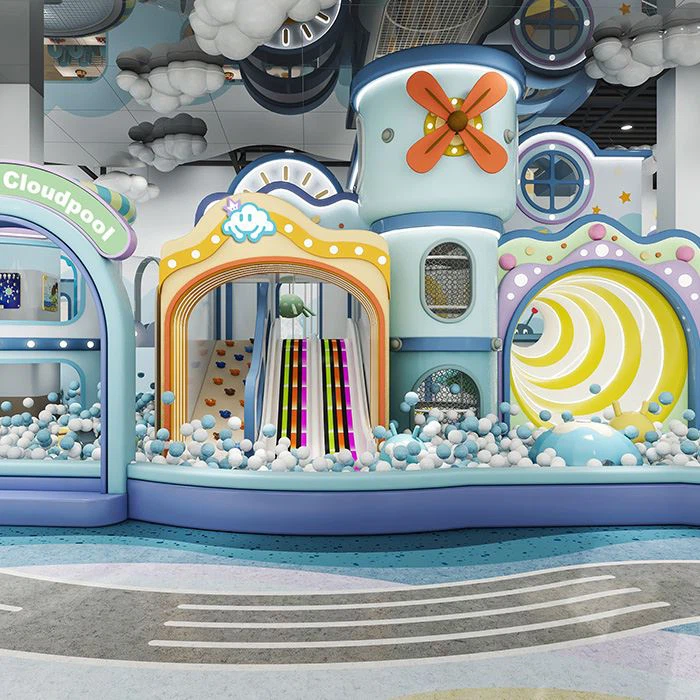
Sensory integration is a vital aspect of cognitive development, and modern indoor playgrounds are designed to provide a rich sensory experience. Sensory integration spaces are filled with elements that stimulate the five senses: sight, sound, touch, taste, and smell. For example, a ball pit with balls of different colors, textures, and sizes can be a great sensory experience. Children can feel the smoothness or roughness of the balls, see the bright colors, and hear the sound of the balls as they move around.
There can also be areas with musical instruments, where kids can explore different sounds and rhythms. This not only enhances their auditory skills but also helps with creativity and self - expression. Tactile walls with various textures, like sandpaper, fur, and smooth plastic, allow children to explore different sensations through touch. These sensory experiences help the brain process information more effectively and improve cognitive functions.
Educational Signage and Displays
Incorporating educational signage and displays is an excellent way to promote cognitive development in indoor playgrounds. These signs can provide information about different topics, such as animals, plants, or historical events. For example, in a jungle - themed playground, there could be signs with facts about different jungle animals, their habitats, and behaviors. This not only educates children but also sparks their curiosity and encourages them to learn more.
Displays can also be used to teach basic concepts like numbers, letters, and shapes. For instance, a large number display with interactive elements where children can touch and manipulate the numbers can help them learn counting and basic arithmetic. Educational signage and displays make learning fun and accessible, turning the playground into an informal classroom.
Technology - Integrated Areas
In the digital age, technology has become an integral part of our lives, and modern indoor playgrounds are no exception. Technology - integrated areas can offer a unique learning experience for children. For example, virtual reality (VR) stations can transport kids to different worlds, whether it's exploring the solar system or diving into the deep sea. VR experiences can enhance spatial awareness, problem - solving skills, and scientific knowledge.
Interactive touch - screen games are also a great addition. These games can be designed to teach various subjects, such as math, language, and science. They provide immediate feedback, which helps children learn from their mistakes and improve their skills. Technology - integrated areas in indoor playgrounds keep children engaged and excited about learning.
Themed Designs
Themed designs play a significant role in cognitive development. A well - thought - out theme can create a cohesive and immersive environment that captures children's imaginations. For example, a Fruit-and-Vegetable-Themed Play Cafe Design can teach kids about healthy eating habits while having fun. They can role - play as farmers, pick fruits and vegetables, and learn about different types of produce.
A Cowboy Play Cafe Equipment theme can transport children to the Wild West, where they can learn about history, culture, and the skills of a cowboy. Themed designs not only make the playground more appealing but also provide a context for learning, which helps children better understand and retain information.
Social Interaction Spaces
Cognitive development is not just about individual learning; it also involves social interaction. Modern indoor playgrounds should have spaces that encourage children to interact with each other. Group play areas, such as large play structures or team - based games, are great for developing social skills. When children play together, they learn how to share, take turns, cooperate, and resolve conflicts.
These social interaction spaces also provide opportunities for children to learn from each other. They can exchange ideas, share experiences, and develop a sense of community. By interacting with their peers, children improve their communication skills, emotional intelligence, and overall cognitive development.
Safety and Comfort
While focusing on cognitive development, safety and comfort are also of utmost importance. A safe and comfortable environment allows children to fully engage in play and learning. Modern indoor playgrounds should be designed with high - quality materials that meet safety standards. Soft flooring, padded structures, and proper ventilation are essential features.
Comfortable seating areas for parents and caregivers are also important. When parents are comfortable, they can better supervise their children and participate in their play. A well - designed indoor playground that prioritizes safety and comfort creates a positive learning environment for children.
Conclusion
In conclusion, modern indoor playgrounds have the potential to be powerful tools for cognitive development. By incorporating interactive zones, sensory integration spaces, educational signage, technology - integrated areas, themed designs, social interaction spaces, and ensuring safety and comfort, these playgrounds can provide a holistic learning experience for children.
If you're interested in creating a modern indoor playground that promotes cognitive development, I'd love to have a chat with you. Whether you're a school, a daycare center, or a business looking to open a play cafe, we can work together to design a space that meets your specific needs. Just reach out, and we can start the journey of creating an amazing indoor playground.
References
- Berger, K. S. (2018). The Developing Person Through the Life Span. Worth Publishers.
- Piaget, J. (1952). The Origins of Intelligence in Children. International Universities Press.
- Vygotsky, L. S. (1978). Mind in Society: The Development of Higher Psychological Processes. Harvard University Press.