

Your Professional Ocean Playground Supplier
Guangzhou cowboy recreation equipment co.,ltd is one of the leading suppliers in China, we have been specializing in the field of kids indoor playground equipment for over many years. We strive to achieve our quality objective by following a Quality Control System based on international standard.
With our great efforts and continuous improvement in quality, we enjoy a high reputation in domestic and East, as well as other countries and regions.
-
![Indoor Playground Equipment Supplier for Themed Kids' Play Centers]()
-
![Ocean Themed Indoor Playground]()
Ocean Themed Indoor Playground
Add to Inquiry -
![Ocean Theme Indoor Playground For Kids Cafe]()
Ocean Theme Indoor Playground For Kids Cafe
Add to Inquiry -
![Ocean Theme Custom Soft Play Equipment]()
Ocean Theme Custom Soft Play Equipment
Add to Inquiry


Why Choose Us?

Rich Experience
Cowboy was established in 2003 in Guangzhou, china. As a professional manufacturer in indoor playground industry, Cowboy has been specialized in the design, production, marketing and installation of kids' playground. After fast development in the past 15 years, nowadays we own build overseas subsidiaries around the world to better serve our clients.

Broad Market
Our main markets are China, Southeast Asia, Australia, Middle East, Europe, America. Our cases are all over the world, such as Jordan, Kuwait, Lebanon, Oman, Qatar, Saudi Arabia, Iran, United Arab Emirates, Palestine, Algeria, Libya, Morocco, Somalia, Israel, India, Africa, USA, Philippines, Vietnam, Thailand, Malaysia, Singapore, Indonesia, Kazakhstan, Uzbekistan Stan, Cyprus, Russia, Rwanda, Ethiopia, etc...

Wide Product Range
Customer groups are generally hotel facilities, large shopping malls, cultural tourism landscape facilities, school education. Main Product: Theme indoor playground, IP customized indoor playground, Trampoline, Ball pool, Ninja warrior, Role play, Electric game.

Quality Assurance
We have seven quality management systems to ensure that our products are qualified, safe and produced according to standards. Whether it is our raw materials or finished products, we can provide test reports or certificates.

Leading Service
We have a professional project team responsible for the after-sales of the entire project. They are online 24 hours a day and respond to customer information in a timely manner. Our products have a one-year warranty period. After one year, our after-sales team will also have a follow-up service to understand the operation of the product from time to time and provide customers with professional product maintenance guidance. Regarding installation, we have a professional installation team to install in your country, and we can also provide 3D installation drawings, videos or online instructions for installation.
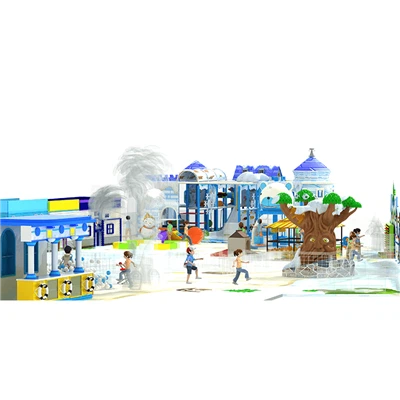
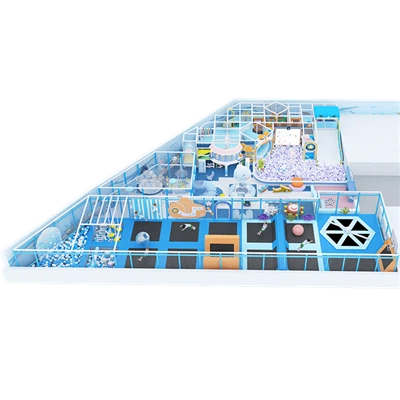
The Ocean Playground is an ocean-themed playground made to bring the concept of water play into landlocked parks or urban settings. The Ocean Playground theme lets children of all ages explore the wonderful world of water, above and below the surface, all without getting wet!
The children can join their friends and swim with the dolphins on the seesaw and springers, or board the pirate ship and hunt for treasure across.

Benefits of Ocean Playground
A Memorable Play Space Playgrounds with unique themes and whimsical elements stand out from the crowd. When you create a one-of-a-kind playground, kids will remember the experience for years to come.
Inspired Play Themed playgrounds inspire kids to use their imaginations. For example, an under-the-sea theme gets kids' creative wheels turning and encourages them to take on an underwater adventure. Kids might gain inspiration to play pretend as octopuses and dolphins, imagine life as a marine biologist or dream up an unlimited number of new experiences.
Cooperative Play Playground themes also get kids playing together by motivating them to engage in the same activities as they play in a common environment. Cooperative play can help kids learn valuable social skills like listening and conflict resolution.
Ease of Playground Design Sticking with a playground theme gives you some direction in planning your play space. You can choose playground elements and pick a color scheme that communicates your theme.
Features of Ocean Playground
Anti-crack
All plastic parts of the Cowboy range are made from LLDPE (Linear Low Density Polyethylene), which is an incredibly strong type of plastic. LLDPE is used where there is a tremendous amount of strength needed to absorb impacts while not tearing or puncturing.
Anti-Static
All metal components are galvanized and powder coated, ensuring longevity and durability.
Anti-Skid
All decks, stairs, and bridges are made from galvanized steel, and covered with anti-skid rubber or PVC

Four Safety and Maintenance Tips for Your Ocean Playground
Weather
Hotter environments and very sunny areas will cause sun damage and fading to progress faster over time. Although our HDPE is UV stabilised equipment in these situations will generally need to be considered for replacement components sooner. Timber is not recommended in extreme heat environments.
Coastal & Marine Areas
In these environments where the risk of corrosion is increased substantially, we suggest the use of timber or marine corrosion-resistant materials such as out spectrum max+ range. Using aluminium and stainless steel as the main materials this system is a great option for playgrounds located in schools or parks near the coast or seaside.
Mulch
Undersurfacing is always an issue for maintenance teams. Consider putting rubber landing pads in high-wear areas (e.g. below slides and swings). Also where possible put borders around playgrounds to keep the undersurfacing contained.
Shade
Shade over a playground can extend the lifetime of a playground. A playground under a shade structure is less suspectable to the rays of the sun which break down materials faster and causes fading.
Certificate
With advanced management skills, technology and sophisticated manufacturing machinery, our entire range of products are manufactured under ISO9001:2000 and ISO14001 standard. Furthermore, our products are also tested under various European and Chinese standards such as ASTM, CE, GS, CCC , TUV EN1176 and SASO...

Our Factory
The environment of our factory is clean and orderly, Our products are formed by the combination of machine and hand make. It not only ensures the mass production of the machine, but also guarantees the fineness of hand-made.

Business Process
Project communication
Scene investigation
Planning program
Program review
Quotation confirmation
Determine cooperation
Transportation and installation
After-sales service

Frequently Asked Questions
Q: How long does it take to assemble a playground?
Q: What are the steps to make a playground?
This playground's footprint is 64 square feet: 8 feet on each side. The upper level is 5 feet above ground level, or as high as you need to accommodate a slide.
Find a suitable location for the playground that's close to the house, dry, and with stable ground that you can dig into. Provide a 16-foot buffer zone around the playground. No obstructions such as bushes, rocks, trees, or the house should be in the buffer zone. Do not locate the playhouse under trees with low-hanging limbs.
Lay Out Posts
Stake out the four post locations in a square, using the twine and stakes. To make sure that it is truly square, measure the two opposing diagonals. If the measurements match, the layout is a true square.
WARNING
Before digging, call your local utility location service to identify the location of electrical wires, pipes, and other vital services.
Remove Turf and Grade
If applicable, remove the turf with the flat shovel and level the surface down to bare dirt. Grade the surface until it is level. Check level by placing the bubble level on a two-by-four in different directions on the ground.
Dig Post Holes
With the post hole digger, dig four post holes to below the frost line, plus another 4 inches to account for the gravel base. The width of each post hole should be at least two times the diameter of the post, or about 8 inches wide.
Add Gravel
Pour gravel into the bottoms of the post holes. Measure out about 4 inches of gravel per hole.
Plumb and Set Posts
Set the four-by-fours in the post holes. Support each post individually with scrap two-by-fours set up as braces. Screw one end of the two-by-four to the four-by-four. Stake the other end into the ground.
Add concrete at this point to help stabilize the posts. The concrete should be added dry and brought to about 3 inches below ground level. Use the bubble level to get each post perfectly plumb.
Attach Horizontal Bracing
Attach four of the two-by-tens in a square around the outside of the four-by-four posts. Attach them at the 5-foot-high mark (or your desired upper-level floor height).
Set Posts in Concrete
With the garden hose, slowly fill each post hole with water, letting the water percolate through the dry concrete mix until full. Allow a day for the concrete to fully cure.
Add Sandbox Walls
Similar to the upper horizontal bracing, attach four two-by-tens at ground level to form the walls of the sandbox.
Add Joists
Install ten joist hangers, five on each side of the upper level bracing. Space them 16 inches apart. Insert five of the two-by-tens into the hangers. Secure the joists into the hangers with nails designed for use with joist hangers.
Install Flooring
Install the composite wood flooring on top of the joists, spacing each board by 1/8 inch.
Build Ladder
Cut two of the two-by-fours to 5 feet long. Cut the scrap wood into two 2-foot pieces and use another, fresh two-by-four to cut two more pieces. Screw the pieces together to make a four-rung ladder. Screw the ladder into the upper level bracing and the lower sandbox wall.
Build Rock Wall
Cut two of the two-by-fours to 6 feet long. Cut nine of the two-by-fours in half. Run the resulting 18 pieces of wood across the 6-foot-long pieces to form a ladder-like structure. Space the rungs 1/4-inch apart. Screw the two hinges to the back of the rock wall, at the top. Screw the other side of the hinges to the upper level bracing. Screw rock holds across the rungs in a random fashion.
Build or Add Slide
Screw the slide to the upper level bracing, so that the lip of the slide is flush with the top of the deck.
Build Balusters / Handrail
Use 20 full-size two-by-fours to form the horizontal balusters around the upper level of the playground. You will use five two-by-fours per side, spacing them 8 inches from each other, culminating at a top handrail that is 48 inches high. Create cut-out spaces for the ladder, slide, and any other feature attached to the upper level.
Add Swing
Attach a swing to the side of the DIY playground. You can use a purchased swing set, eliminating one of the side legs. The side of the playground would replace the leg. Or you can build your own swing set from pressure-treated ground contact lumber, again eliminating one of the legs in favor of the playground as a type of leg.
Q: What is the safest surface for a playground?
Q: Why do playgrounds cost so much?
Q: What is the average size of a typical playground?
Q: How many people does it take to build a playground?
Q: What makes a perfect playground?
Q: How is a playground slide made?
Q: What should be included in a playground?
Q: What are the sensory components of a playground?
Tactile experiences like sand or water play are important for stimulating a child’s sense of touch. Water can be soothing to a child who easily experiences sensory overload, and elements like sand can help a child who struggles to cope with certain sensations or demonstrates a sensitivity to touch. A sandbox or sand table also provides the opportunity to incorporate other tactile experiences by incorporating a variety of toys and objects for children to use during sand play.
Swings
Swinging is so much fun that most children, and their parents, don't realize that it works a variety of muscles and joints.
Swinging — independently or with the help of an adult — is a great way for a child to exercise their vestibular system. Swinging is so much fun that most children, and their parents, don’t realize that it works a variety of muscles and joints. The swaying motion offers input for a child’s vestibular, proprioceptive, tactile and visual systems, helping them learn how their bodies move and how to control their bodies better.
These skills can go a long way toward helping a child establish their sense of where their body is in space and recognizing physical boundaries, which is a common problem among children with attention-deficit hyperactivity disorder (ADHD), a processing disorder, or an autism spectrum disorder.
There’s nothing quite like the thrill of swinging alongside a friend and enjoying the sensation of going higher and higher together. Inclusive swing seats can be incorporated among traditional swing seats to allow children of all abilities to swing side-by-side. Plus, swinging is a great way to help a hyperactive or over-stimulated child calm down.
Spinners and Climbing Toys
Spinning equipment, such as the Whirl, Cyclo Cone Base Climber and Maypole make a great addition to a sensory-friendly playground because they provide ample opportunities for children to engage their vestibular system, which is responsible for establishing and maintaining balance. Engaging in these activities goes a long way toward helping children improve their balance and coordination. It also helps children who may struggle with these traits to practice and become more confident in their abilities to move around.
Climbing equipment also encourages children to engage the muscles needed to develop and maintain balance while encouraging them to accept new challenges in a structured, secure environment. There are a wide variety of options available, and an inclusive playground can include climbing options that allow children with disabilities to engage in climbing activities, too.
Outdoor Exploration
A sensory-friendly playground will make the most of its natural setting, allowing children the opportunity to see, hear and smell the world around them. It might mean planting a small sensory garden or including kid-friendly fragrant plants in the nearby landscaping. It might incorporate a small wheelchair-accessible trail near the playground for family exploration. Or, it might include items that make sounds like conga drums or a xylophone.
Play Panels
Sensory play panels offer fun textures and sights in child-friendly elements. Play panels could include interactive elements like a rotating sphere filled with pebbles to watch. They could also take the form of a sensory maze, where kids can weave their way through translucent panels with textured shapes.
Gentle Colors
Visual stimulation comes through incorporating colors throughout the playground. Colors can be incorporated in various ways, including flooring options. They can also be used to distinguish between different heights and types of equipment. The tasteful use of colors and patterns can encourage children to engage and explore. Sensory playgrounds often use gentle colors so as not to overwhelm kids.
We're professional ocean playground manufacturers and suppliers in China, specialized in providing high quality customized design service. We warmly welcome you to wholesale ocean playground for sale here from our factory. For price consultation, contact us.
indoor play seesaw, indoor play design entertainment, indoor play entertainment