

How To Open A Play Cafe
Want to figure out how to open a play cafe? Sunrise Play Cafe in the US unlocks new parent-child scenes and ways to get party profits.
- Fast Delievery
- Quality Assurance
- 24/7 Customer Service
Product Introduction
While parents are still wondering "where to take their kids", and entrepreneurs are searching for low-risk, high-return business projects, play cafes have become popular spots in cities with the properties of childcare, socializing, and consuming. For those figuring out how to open a play cafe, understanding this model is the first step.

Today, let's break down the core logic of play cafes: Who are the main customer groups? How to make a fortune through parties? What kinds of activities are available in different areas? Are they suitable for children of all age groups? All the answers are right here!

1. Accurately Target Three Core Customer Groups and Capture the Main Consumer Force
The customer groups of play cafes are not "all parents", but three groups with clear profiles. Capturing them is equivalent to seizing the key to traffic:
Mothers with babies aged 0-6: This is the most core customer group! Especially stay-at-home mothers or working mothers, they need a kid-care scene where they can "free their hands"-allowing kids to play freely while they can have a cup of coffee and chat with girlfriends, avoiding the tiredness of "taking care of kids = keeping an eye on them all the time". They have high requirements for environmental safety and hygiene, and are willing to pay for "convenience". A single consumption usually includes drinks, light meals, and they may also buy children's toys or peripherals on a whim.
Families that value a sense of ritual: Such families attach great importance to the important stages of their children's growth, such as the 1st birthday, the 3rd birthday (entrance to kindergarten), and festival celebrations (Children's Day, Christmas, New Year), etc. They are not satisfied with simple celebrations at home, but hope to have professional scenes, decorations, and services to create unforgettable memories for their children. At the same time, they can also invite relatives and friends to participate. The "themed parties" of play cafes just meet their needs, and the average customer spending is often 3-5 times that of daily consumption. Understanding this is crucial when planning how to open a play cafe that stands out.
Parent-child communities and educational institutions: Local mother groups, early education centers, and kindergartens often need offline activity venues, and the "semi-open venue rental" model of play cafes is very popular. For example, early education centers hold "parent-child handicraft classes" and "picture book reading sessions", and communities organize "baby crawling competitions" and "mother's afternoon tea". Such cooperation can not only bring stable customer flow but also attract more individual customers through word-of-mouth communication, which is a win-win model of "batch customer acquisition and brand linkage".
2. Party Profit: The Key from "One-time Consumption" to "Long-term Repurchase"
The core profit of play cafes is far more than coffee and light meals. It is the high customer unit price and repurchase rate brought by "themed parties". Learning how to open a play cafe with a strong profit strategy means mastering party offerings. How to operate it specifically? These three directions are the most popular:
Children's Birthday Parties: Customized Services for Parents to "Bring Only Themselves"
This is the most basic and necessary type of party, and the key lies in "convenience + uniqueness". You can launch packages at different prices: the basic package includes venue decoration (balloons, themed background boards), children's meals (cartoon-shaped hamburgers, fruit platters), cakes, and interactive games (such as clown shows, magic shows); the high-end package adds photographer follow-up shooting, souvenirs (customized toys, stationery), and parent-child DIY sessions (such as making cookies and painting T-shirts together).
Holiday-Themed Parties: Seize the Opportunity for Marketing and Increase Store Visits
Using legal holidays or parent-child-related festivals to hold themed activities can effectively drive customer flow on non-weekends. For example, on Christmas, launch a "parent-child Christmas dinner" including a Christmas turkey dinner, handmade Christmas tree making, and Santa Claus giving gifts; on Mother's Day, focus on "mother-exclusive parties" where children make greeting cards and apply lipstick for their mothers, and mothers can enjoy free manicures and afternoon tea while fathers take care of the kids. This design that "takes into account the needs of parents" can make families willing to consume many times.
Growth-Themed Parties: Bind Long-term Needs and Build the Image of "Parent-Child Growth Partner"
In addition to birthdays and festivals, you can also design parties according to the growth stages of children, such as "1-year-old party", "3-year-old kindergarten adaptation party", and "6-year-old transition to primary school encouragement party". Such parties have more emotional value and can make parents feel the "professionalism" of the play cafe. Such parties not only make money but also turn the play cafe from a "consumption place" into a "parent-child growth partner". When parents have any needs related to taking care of their children in the future, they will think of this place first, and the repurchase rate will naturally be higher.
3. Activity Zones: Covering Ages 0-12, Let Kids of All Ages "Have a Great Time"
The "soul" of a play cafe lies in the design of activities, which must take into account the needs of children of different age groups to avoid the embarrassment that "older kids find it childish and younger kids find it dangerous". A critical part of learning how to open a play cafe is mastering the play cafe design zones to create a safe and engaging environment. Reasonable zoning is the key. Here are three core zones recommended:
Toddler Exploration Zone (0-2 Years Old): Safety First, Focus on Sensory Development
Babies of this age can't walk yet or have just learned to walk, so the focus is on "safety + soft environment". The floor in the zone should be covered with non-slip floor mats. Place soft building blocks, tactile balls, plush toys, baby crawling tunnels, and other specialized play cafe equipment, and avoid sharp edges and corners. At the same time, hang colorful cognitive posters on the walls to meet the needs of the baby's visual development. This zone doesn't need to be too large, but it must be clean and quiet, so that parents can rest assured to let their babies play in it.

Educational Play Zone (3-6 Years Old): Hands-on + Socialization, Release Energy
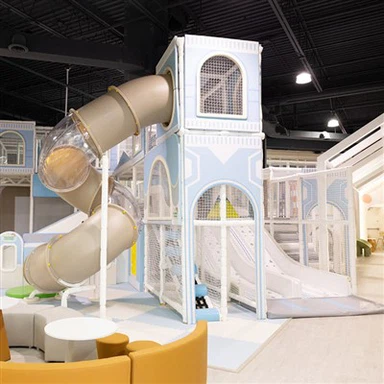
This is the "core play zone" of the cafe, which should take into account both "hands-on ability" and "social needs". You can place large building block tables, role-playing zones (small kitchens, small supermarkets, doctor toy sets), reading corners, and handcraft tables. You can also add a "small ball pool + slide" to meet the children's sports needs, but pay attention to regular disinfection and post a "parent accompaniment" reminder. The design of this zone should be open, so that parents can see their children's movements, and at the same time, reserve enough seats for parents to rest at any time. Selecting the right indoor play solutions for this age group is crucial for keeping them engaged.


Parent-Child Interaction Zone: Focus on "Parent Participation" to Enhance Stickiness
Many parent-child places only focus on children, but ignore the parents' experience. This zone is the key to "retaining parents". You can set up a parent-child baking platform, a parent-child painting wall, and a table game zone. In addition, set up a "parent rest area" next to this zone, providing free WiFi, charging sockets, magazines, and even a "mini manicure corner" and "massage chairs" to allow parents to relax while accompanying their children. When parents are satisfied, they will be willing to bring their children here often. Knowing how to open a play cafe that caters to both children and adults is a major advantage.

In the final analysis, a play cafe is not a simple combination of "cafe + toys", but a scenario-based consumption that "solves the pain points of parents taking care of their children". It has accurate target customers, a clear play cafe business model (daily consumption + party profit), and activity designs covering all age groups. As long as you do a good job in the four key points of "safety, hygiene, service, and characteristics", you can stand out in the fierce market competition. For anyone researching how to open a play cafe, focusing on a solid play cafe profit strategy is the foundation of success.
Whether parents are looking for a "good place to take their kids" or entrepreneurs are looking for a "low-risk physical business project", play cafes are a popular choice worth paying attention to. After all, a business that "makes children happy and parents worry-free" will always have a market! If you're serious about learning how to open a play cafe, start by refining these core concepts.
Click here to see more play cafe designs > >
Hot Tags: How To Open A Play Cafe, China How To Open A Play Cafe manufacturers, suppliers, factory